Stage
Phones and the Router
Hours of a router and a phone on charge from a 288 Wh power station, computed from the same device figures the tables use. Adding a laptop to that load cuts it to under a third. An estimate, not a guarantee.
What this stage covers
This is where stored energy first earns its place. A small power station covers the loads that are cheap in watt-hours and expensive in inconvenience: phones, a laptop, a lamp, and the network gear. It is also where a surge protector belongs, because a single AC outlet on a small unit is not enough sockets and improvising that is where people get hurt.
What this stage does not cover
Every stage on this site states its own limits before it states what to buy. These are the things that are still unsolved after this stage is complete.
- The refrigerator. A sub-300 Wh unit does not have the stored energy or, in most cases, the stated output to start a compressor.
- Anything that produces heat. Space heaters, microwaves, kettles, and air fryers are all beyond the stated output of every small unit here.
- A multi-day outage. This stage covers a day, and refilling the unit assumes utility power comes back.
- Internet service, as opposed to your router. If the provider equipment in the neighborhood is dark, powering your router changes nothing.
Do this first
Some of this costs nothing, and the free parts are the ones that get skipped.
- Write down what you would actually want running on day one. The Load List Builder on this site turns that into watt-hours, and the answer is usually smaller than people expect.
- Check the wattage printed on each device's power adapter, since that is the number your own arithmetic should use rather than any figure on this site.
- Charge over USB where you can rather than through a wall brick on the AC outlet. Going through the inverter to reach a charger wastes energy at both ends.
- Decide where the power station will live and keep it there, charged, on the top-up interval in its manual.
What to buy at this stage
Portable Power Stations
Core job: storing watt-hours and giving them back as household AC
Because the loads at this stage are small, steady, and resistive, which is exactly what a sub-300 Wh unit handles well, and because it gives you a household AC outlet without a single moving part.
Highest stated AC output here, 1800 W
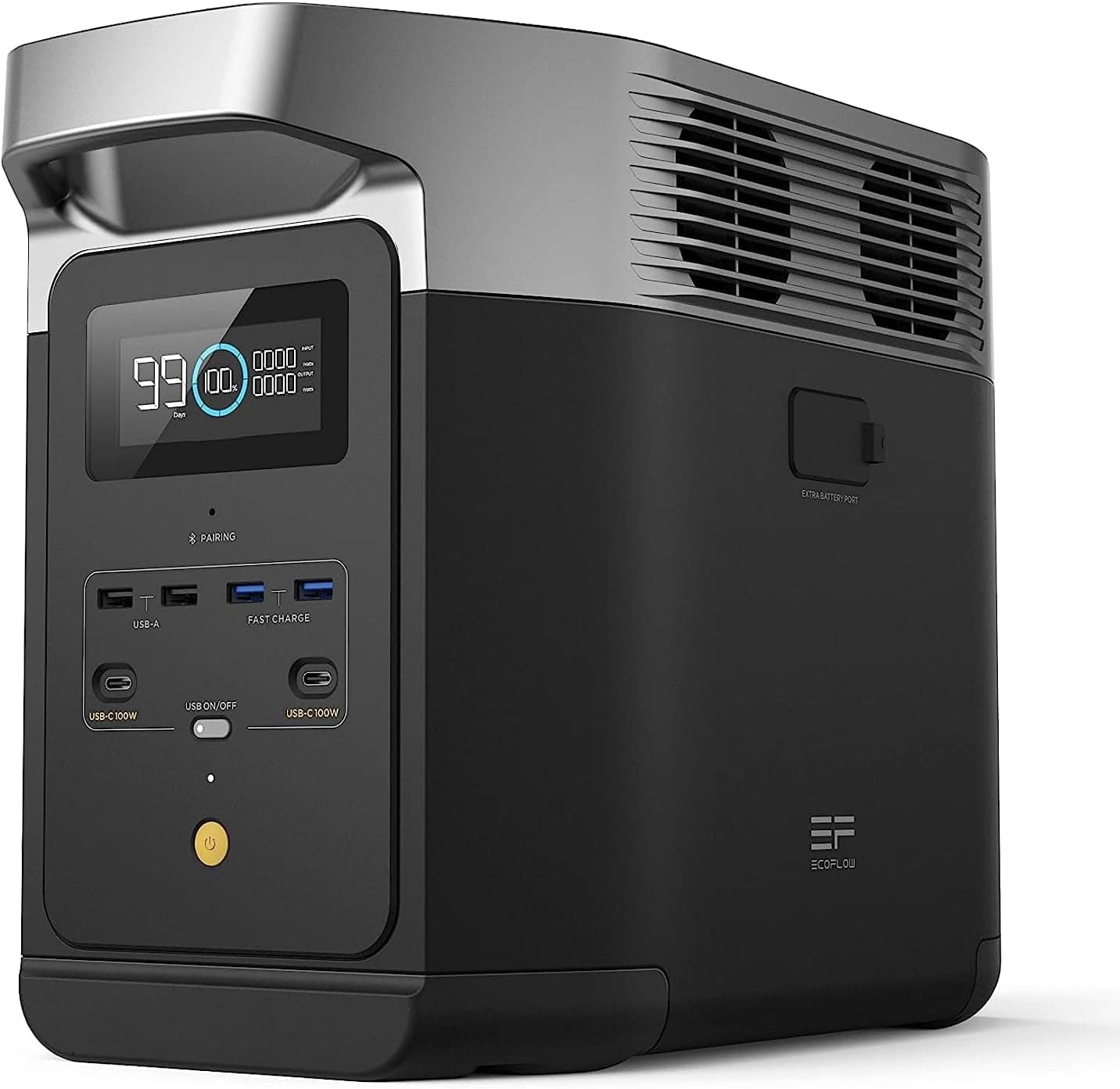
EcoFlow Delta 2 Power Station, 1024 Wh
The listing states 1024 Wh of LiFePO4 storage behind an 1800 W AC output, which is the highest continuous figure stated by any unit in this catalog. That combination is what the category is for: a large reserve of watt-hours and an inverter big enough to hand them back through a household plug. The listing states the solar panel is optional and sold separately, and no panel is included here.
- Stated capacity
- 1024 Wh
- Stated AC output
- 1800 W
- Stated USB-C output
- 100 W
- Chemistry, as the listing states
- LiFePO4
- Solar panel
- Optional and sold separately, per the listing
What it does well
- The listing states the highest continuous AC output in this catalog at 1800 W, which is what decides whether a load runs at all.
- The listing states LiFePO4 cells, the chemistry associated with longer rated cycle life on units that sit unused for years.
- The listing states a 100 W USB-C port, so laptops and phones can be charged without routing through the AC inverter.
- A stated 1024 Wh reserve is enough to put a fridge on the list of things you can consider, rather than only lights and phones.
Where it falls short
- No solar panel is included, and none is sold on this site, so the wall outlet is the only recharge path covered here.
- The listing does not state a peak or surge figure separately from the 1800 W continuous output, so motor starting headroom is unstated.
- At this capacity the unit is a two-handed carry, which limits how casually it moves between floors.
Best forThe household that has already handled lights and phones and now wants the fridge to survive a long night.
Surge Protectors & Power Strips
Core job: one outlet becoming several, safely
Because the small units have one AC outlet and you will have three things to plug in, and because the alternative people improvise instead is the thing that starts fires.
Stated TUV listing alongside 12 AC outlets
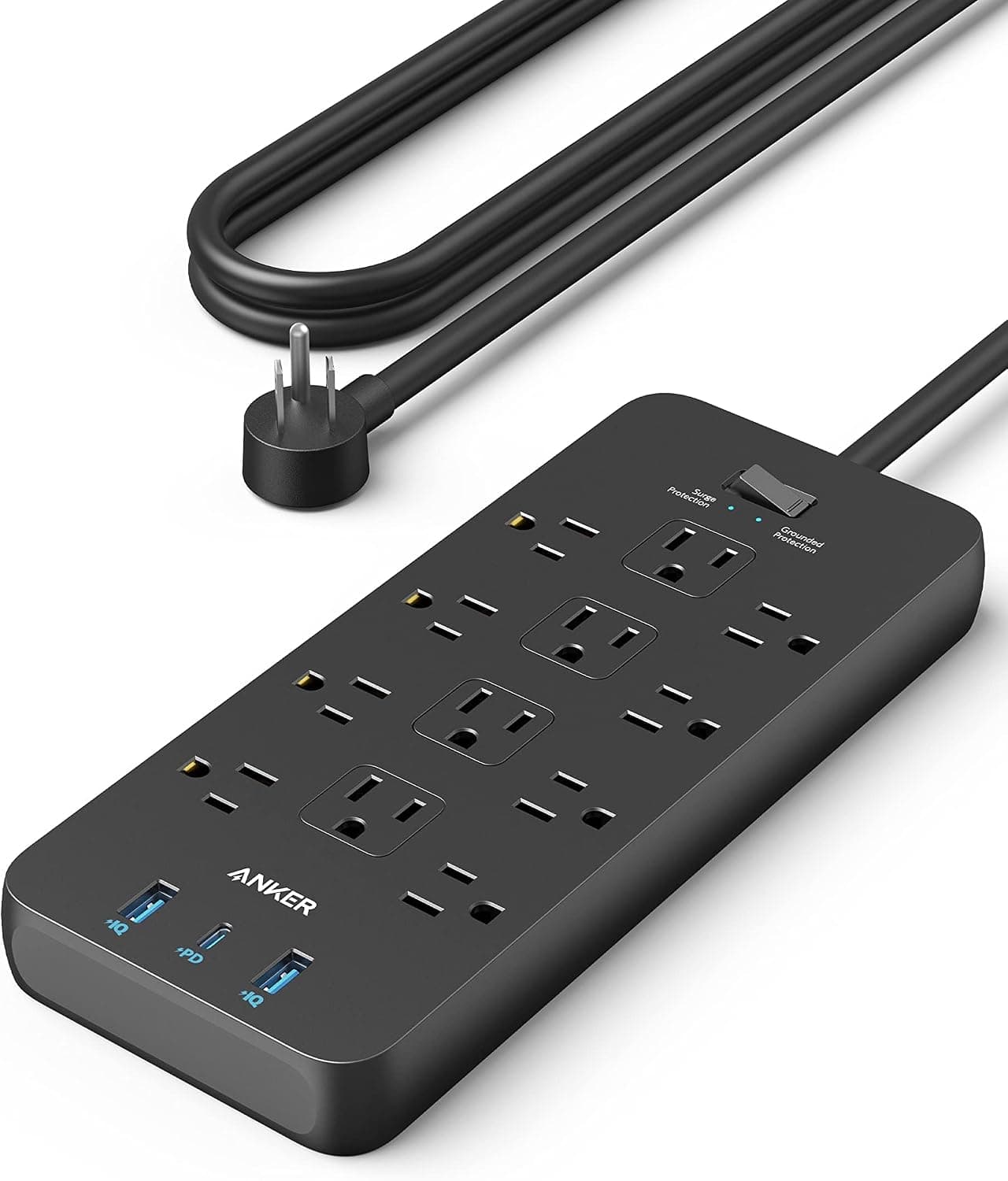
Anker Power Strip, 12 AC, 2100 J
The listing states 12 AC outlets, a 5 ft cord, one USB-C and two USB-A ports at 20 W, and a TUV listing. The certification mark is the reason this sits first: it is a verifiable claim about the unit having been tested, which a joule number on its own is not. The listing states 2100 J, reported here as stated.
- AC outlets
- 12
- Joules, as the listing states
- 2100 J
- Stated cord
- 5 ft
- Stated USB
- 1 USB-C, 2 USB-A, 20 W
- Stated certification
- TUV listed
What it does well
- The listing states a TUV listing, which is a testing claim you can look up rather than take on faith.
- Twelve stated AC outlets covers a desk or a shelf without a second strip.
- A stated 20 W USB-C port charges a phone directly, avoiding the loss of a wall brick on an inverter.
- A 5 ft cord is long enough for most placements without becoming a trip hazard.
Where it falls short
- A stated 2100 J is not the highest figure in this catalog.
- Twelve outlets in one strip invites overloading a single wall receptacle.
- The 5 ft cord ties for the shortest here, which limits where it can sit.
Best forA desk or media shelf where a certification mark matters more than the largest joule number.
What not to buy yet
This block appears on every stage, and it is the part that separates a sequence from a catalog. Buying these things now is not dangerous; it is just out of order, and out of order is how people end up with the wrong equipment for the outage they actually get.
A second power strip to chain onto the first
Chaining strips is a recognized fire cause and it defeats the protection circuitry in both. If the first one does not reach, the answer is a longer cord, not a second strip.
The largest power station in the catalog
Nothing at this stage needs it, and a two-handed box gets left in one room. Move up when the fridge becomes the goal, which is the next stage.
A solar panel
None are sold here, none are included with any unit in this catalog, and this site does not estimate solar recharge or recommend panel sizes.
What skipping this stage costs
Skipping this stage means the household loses contact with the outside in the first day, which is the day when the information about how long the outage will last is worth the most. It also means the improvised outlet arrangement gets built anyway, out of whatever is in the drawer.
The loads this stage is about
| Device | Running draw | Duty share | Average draw used | Starting surge | Est. hours |
|---|---|---|---|---|---|
| Phone Charging | 12 W | Continuous | 12 W | No | 73 h |
| Router and Modem | 15 W | Continuous | 15 W | No | 58 h |
| Laptop | 45 W | Continuous | 45 W | No | 19 h |
| LED Lighting | 30 W | Continuous | 30 W | No | 29 h |
The hours divide the average draw, not the running draw, so the duty share column is what reconciles the two: average draw is running draw multiplied by the duty share, and hours are (1024 x 0.85) divided by that average. These are estimates produced by the site formula, not guarantees, and they do not account for startup surge, temperature, or battery age.
The next stage
Finish this one before moving on. The order is the argument.