Stage
The Fridge Through the Night
Hours of refrigeration from a 1024 Wh unit, with the 35 percent compressor duty share applied and the door kept shut. Computed from the refrigerator device page, so the two cannot disagree. An estimate, not a guarantee.
What this stage covers
This is the stage people think they are buying at when they walk into the category, and it is the first one where the specification that matters is not capacity. A compressor demands a spike of current to start that has nothing to do with what it draws afterward, and a unit that clears the running wattage can still refuse the load outright.
What this stage does not cover
Every stage on this site states its own limits before it states what to buy. These are the things that are still unsolved after this stage is complete.
- Any guarantee that a specific power station will start a specific refrigerator. That depends on surge behavior neither the appliance nor most listings publish.
- Heating or cooling the house. Space heaters and air conditioners are beyond what any unit here can sustain.
- A multi-day event. One charge is one charge, and this stage assumes the utility comes back within a day or so.
- A sump pump. It is a harder starting load than a fridge and no stage in this sequence covers it, because in the weather that takes the power out it runs close to continuously. That job belongs to a dedicated battery backup pump installed by a licensed plumber.
Do this first
Some of this costs nothing, and the free parts are the ones that get skipped.
- Read the nameplate on your refrigerator, inside the door or on the back, and use that wattage rather than any general figure.
- Practice keeping the door shut. An unopened refrigerator holds temperature for hours on its own, which is free and works before any battery is involved.
- Move what matters into the freezer compartment or a cooler with ice, and decide in advance what is worth saving.
- Run the Runtime Estimator on this site with your own numbers, then read the list of what the estimate leaves out. That list is the honest part.
- Read what your power station's manual says about motor loads and startup behavior before assuming the fridge is covered.
What to buy at this stage
Portable Power Stations
Core job: storing watt-hours and giving them back as household AC
Because a 1000 Wh class unit is the first size where refrigeration is a realistic proposition rather than an optimistic one, and because the stated continuous output at that size is what gives a compressor any chance of starting.
Highest stated AC output here, 1800 W
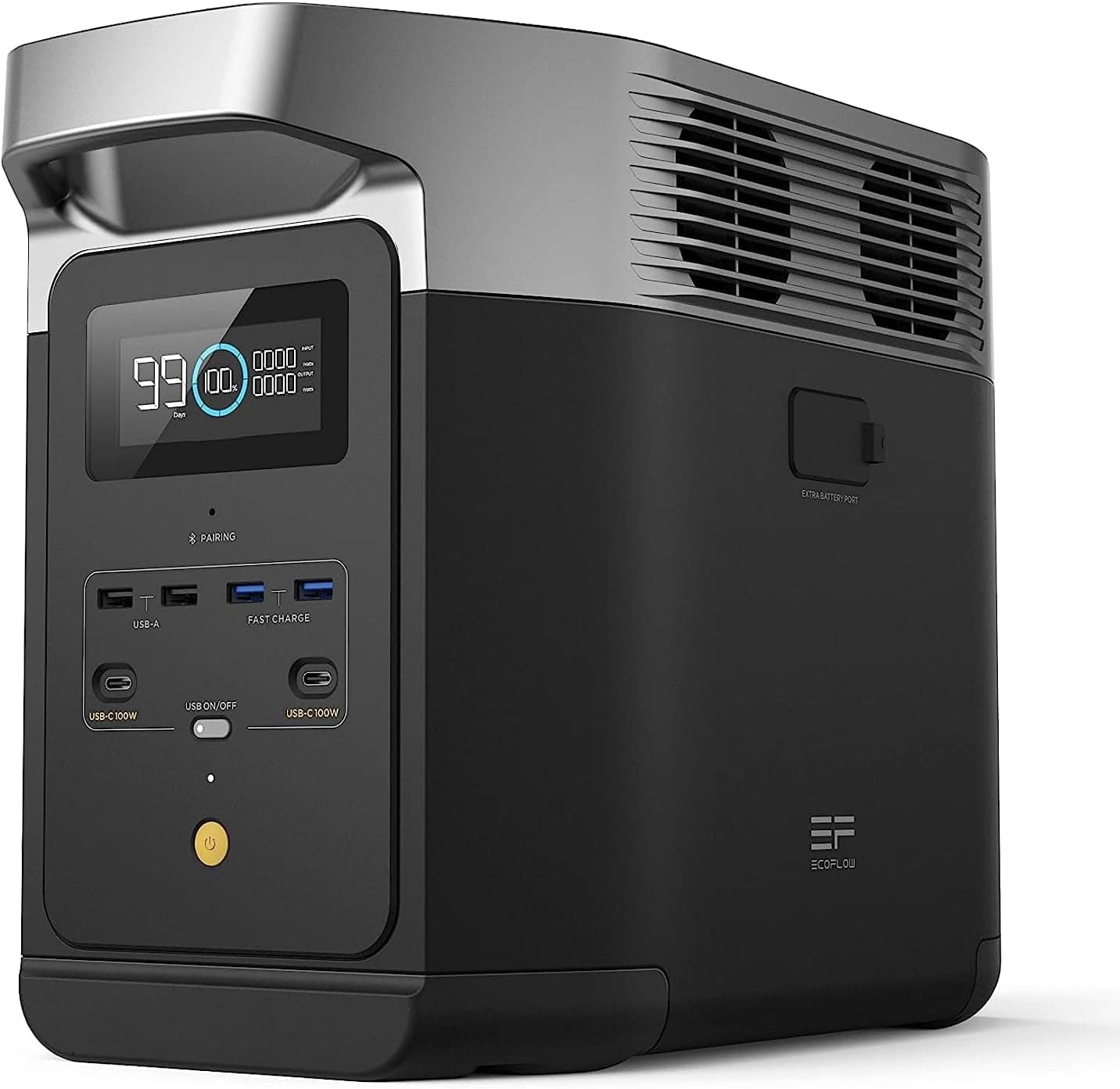
EcoFlow Delta 2 Power Station, 1024 Wh
The listing states 1024 Wh of LiFePO4 storage behind an 1800 W AC output, which is the highest continuous figure stated by any unit in this catalog. That combination is what the category is for: a large reserve of watt-hours and an inverter big enough to hand them back through a household plug. The listing states the solar panel is optional and sold separately, and no panel is included here.
- Stated capacity
- 1024 Wh
- Stated AC output
- 1800 W
- Stated USB-C output
- 100 W
- Chemistry, as the listing states
- LiFePO4
- Solar panel
- Optional and sold separately, per the listing
What it does well
- The listing states the highest continuous AC output in this catalog at 1800 W, which is what decides whether a load runs at all.
- The listing states LiFePO4 cells, the chemistry associated with longer rated cycle life on units that sit unused for years.
- The listing states a 100 W USB-C port, so laptops and phones can be charged without routing through the AC inverter.
- A stated 1024 Wh reserve is enough to put a fridge on the list of things you can consider, rather than only lights and phones.
Where it falls short
- No solar panel is included, and none is sold on this site, so the wall outlet is the only recharge path covered here.
- The listing does not state a peak or surge figure separately from the 1800 W continuous output, so motor starting headroom is unstated.
- At this capacity the unit is a two-handed carry, which limits how casually it moves between floors.
Best forThe household that has already handled lights and phones and now wants the fridge to survive a long night.
What not to buy yet
This block appears on every stage, and it is the part that separates a sequence from a catalog. Buying these things now is not dangerous; it is just out of order, and out of order is how people end up with the wrong equipment for the outage they actually get.
A unit chosen on capacity alone
Watt-hours tell you how long a load runs once it has started. They tell you nothing about whether a compressor can start at all, which is decided by output and surge behavior.
An extension cord run to the fridge from another room
Long cords and improvised routing are how the wrong problem gets solved. Move the battery to the fridge, not the electricity across the house.
A second large battery
Doubling storage before you have confirmed the first unit will start the load is doubling an unproven assumption. Confirm the combination works, then decide about capacity.
What skipping this stage costs
Skipping straight to this stage from nothing is the most common mistake in the category: a large battery arrives, the household still has no flashlight, no jump pack, and no surge protector, and the fridge turns out not to start anyway because nobody checked the surge behavior. Everything in the earlier stages costs less and fails less often.
The loads this stage is about
| Device | Running draw | Duty share | Average draw used | Starting surge | Est. hours |
|---|---|---|---|---|---|
| Refrigerator | 150 W | 35% | 52.5 W | Yes | 17 h |
| Chest Freezer | 100 W | 30% | 30 W | Yes | 29 h |
| Box Fan | 60 W | Continuous | 60 W | Yes | 15 h |
The hours divide the average draw, not the running draw, so the duty share column is what reconciles the two: average draw is running draw multiplied by the duty share, and hours are (1024 x 0.85) divided by that average. These are estimates produced by the site formula, not guarantees, and they do not account for startup surge, temperature, or battery age.
The next stage
Finish this one before moving on. The order is the argument.